

Cisco Catalyst 9120AX: the hardware decision in one view
The Cisco Catalyst 9120AX Series is a Wi-Fi 6 enterprise access-point family built around four spatial streams, flexible radio operation, multigigabit Ethernet, and Cisco management options. The practical purchase decision is determined by three hardware questions: whether the installation needs internal or external antennas, whether a professional installation model is required, and whether the access point should include a Cisco Embedded Wireless Controller.
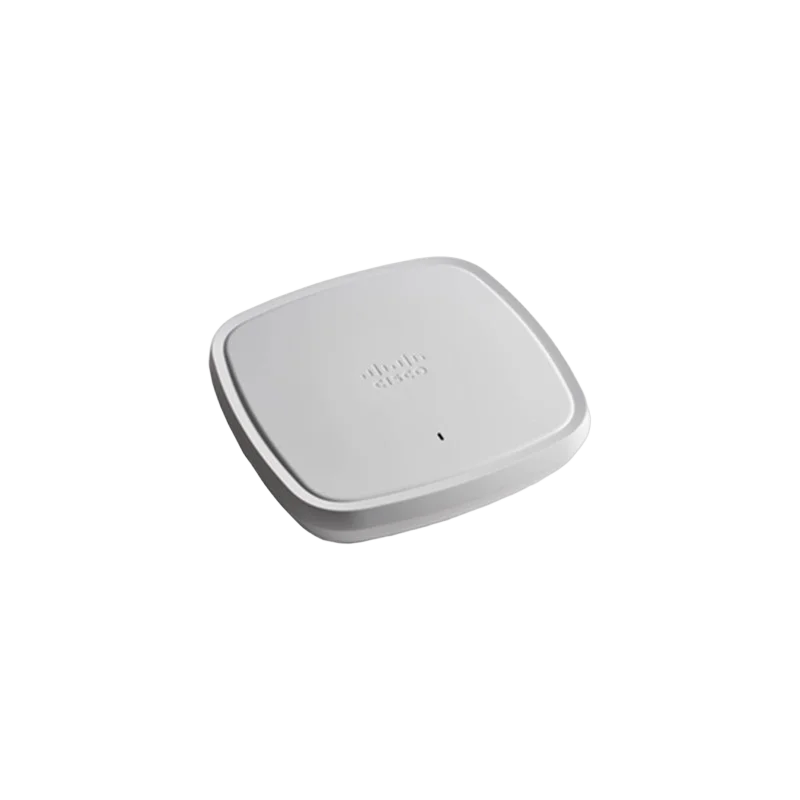
The documented hardware families are C9120AXI-x for indoor areas with internal antennas, C9120AXE-x for indoor challenging environments using external antennas, and C9120AXP-x for indoor professional installations. Each of those form factors is also available with an embedded controller variant using the C9120AXI-EWC-x, C9120AXE-EWC-x, or C9120AXP-EWC-x designation. The final regulatory-domain character must be verified for the intended country before an order is placed.
Cisco specifies up to 5.38 Gbps PHY data rate for 802.11ax using 160-MHz operation on 5 GHz and 20-MHz operation on 2.4 GHz. That figure is a radio-layer maximum, not an expected application throughput figure. Real capacity depends on channel width, client capability, airtime contention, signal quality, protocol overhead, and the wired uplink.
C9120AXI, C9120AXE, and C9120AXP model boundaries
The three physical variants use the same general Wi-Fi 6 platform but address different antenna and installation conditions. Selecting among them should begin with the building survey rather than the feature list.
| Model family | Antenna approach | Physical orientation | Best fit | Procurement consideration |
|---|---|---|---|---|
| C9120AXI-x | Internal antennas | Indoor general-purpose access point | Offices, classrooms, meeting rooms, and standard indoor coverage | Simplifies installation where the coverage pattern is suitable |
| C9120AXE-x | External antennas | Indoor challenging environment | Large open areas, difficult RF layouts, and designs requiring antenna choice | Antennas are sold separately and must be engineered with the AP |
| C9120AXP-x | External antenna support | Indoor professional installation | Auditoriums, convention areas, libraries, cafeterias, arenas, and stadium-type spaces | Supports higher-gain antenna arrangements documented for the model |
| C9120AXI-EWC-x | Internal antennas with embedded controller | Indoor general-purpose deployment | Smaller or distributed WLANs that want controller functionality on the AP | Confirm the embedded-controller operating design before standardizing |
| C9120AXE-EWC-x | External antennas with embedded controller | Indoor challenging environment | Specialized RF layouts without a separate physical controller | Requires both antenna planning and controller-role planning |
| C9120AXP-EWC-x | External antenna support with embedded controller | Professional installation | High-density or venue deployments requiring local controller capability | Validate regulatory and antenna details before ordering |
The suffix x represents the regulatory domain. Cisco states that customers are responsible for verifying approval in their own country, and not all regulatory domains are necessarily available at the same time. Therefore, a quote or bill of materials should preserve the complete documented suffix rather than replacing it with a generic C9120AX label.
Radio architecture and capacity implications
The Catalyst 9120AX uses a dedicated 5-GHz radio and a flexible radio that can operate on either 2.4 GHz or 5 GHz. In the standard arrangement, one radio serves 2.4-GHz clients while the other serves 5-GHz clients. Flexible Radio Assignment can instead place both radios in 5-GHz client-serving mode, increasing 5-GHz client capacity where the RF plan supports that choice.
With dual 5-GHz operation, Cisco describes combined over-the-air speeds of 5.2 Gbps, represented as two 2.6-Gbps radio links. This is a useful capacity indicator for dense environments, but it should not be treated as a single client speed or as a guaranteed aggregate application rate. Wi-Fi is a shared medium: many clients divide airtime, and a low-rate or distant client can consume disproportionate airtime compared with a nearby high-rate client.
The platform supports four spatial streams and 4×4 operation on the relevant radios. MU-MIMO can distribute spatial streams among multiple clients, while OFDMA divides a channel into resource units for scheduled uplink and downlink transmissions. These mechanisms address different traffic patterns. MU-MIMO is useful when several compatible clients can be served spatially, whereas OFDMA improves scheduling efficiency for many smaller transmissions and short packets.
BSS coloring enables spatial reuse by helping neighboring basic service sets distinguish transmissions. Target Wake Time allows compatible battery-powered clients to wake on scheduled intervals, reducing unnecessary listening time. These functions improve network behavior under specific client and RF conditions; they do not remove the need for channel planning, minimum data-rate policy, or correctly positioned access points.
Wi-Fi 6 modes, channel widths, and advertised rates
The documented platform supports 802.11n, 802.11ac, and 802.11ax. For 802.11ax, supported channel widths include 20, 40, 80, and 160 MHz, with a stated maximum PHY rate of 5.38 Gbps. The 802.11ac specification reaches up to 3.47 Gbps PHY rate using 160-MHz operation and four spatial streams.
| Wireless capability | Published specification | Engineering meaning | Best use |
|---|---|---|---|
| 802.11n | Up to 890 Mbps PHY | Supports legacy and mixed client environments | Existing client populations and compatibility requirements |
| 802.11ac | Up to 3.47 Gbps PHY | Adds wider channels and downlink MU-MIMO | High-throughput modern client areas |
| 802.11ax | Up to 5.38 Gbps PHY | Adds OFDMA, TWT, BSS coloring, and higher efficiency | Dense offices, collaboration spaces, and IoT-heavy WLANs |
| Dual 5-GHz mode | 5.2 Gbps combined over the air | Uses both radios for 5-GHz service | High client density where 5-GHz spectrum is available |
| 160-MHz channel | Supported on 802.11ac and 802.11ax | Provides high peak PHY rates but consumes substantial spectrum | Controlled RF environments with adequate channel availability |
A design using 160-MHz channels should not be assumed to outperform an 80-MHz design in every building. Wider channels can reduce the number of independent channels available for reuse and may interact with DFS requirements. In a dense office, more predictable reuse and lower contention may be more valuable than the highest single-link rate.
Multigigabit Ethernet and wired-side sizing
The access point provides one RJ-45 Ethernet interface supporting 100 Mbps, 1 Gbps, and 2.5 Gbps through IEEE 802.3bz. Cisco specifies support for these speeds over Category 5e cabling, as well as 10GBASE-T cabling. The AP also includes an RJ-45 management console port and a USB 2.0 interface rated at 4.5 W.
A 2.5-Gbps uplink is an important selection point because the combined radio capacity can exceed the practical ceiling of a 1-Gbps wired connection in a busy WLAN. A 1-Gbps link may still be appropriate for a standard office with moderate concurrency, controlled application demand, or a network where the access switch cannot provide multigigabit access. It becomes a potential bottleneck when many high-rate clients are active simultaneously, when the AP uses dual 5-GHz operation, or when local application hosting and wireless traffic share the same uplink.
The correct workflow is to check four items together:
- Expected concurrent clients rather than the registered-client total.
- Peak application demand, including collaboration, video, voice, and cloud traffic.
- Access-switch support for 2.5-Gbps negotiation and the required PoE class.
- Cable condition and the actual end-to-end path between AP and switch.
The advertised PHY rate is not a bandwidth reservation. A 5.38-Gbps radio figure does not mean that a 5-Gbps application flow will pass through the 2.5-Gbps Ethernet port. It indicates the upper radio-layer capability under specified modulation, channel width, and spatial-stream conditions.
PoE class, USB operation, and power planning
Cisco documents 802.3at PoE+ and 802.3bt Cisco Universal PoE as input options for the Catalyst 9120AX family. The access point can also operate from 802.3af PoE with reduced radio and interface capability. The specified maximum consumption with PoE+ is 25.5 W for both C9120AXI and C9120AXE or C9120AXP configurations when the listed 4×4 radios, 2.5-Gbps link, and USB operation are enabled.
| Power input | Radio condition shown in specification | Link | USB | Maximum stated consumption | Design interpretation |
|---|---|---|---|---|---|
| 802.3at PoE+ | 4×4 on 2.4 GHz and 5 GHz | 2.5G | Enabled | 25.5 W | Full documented operating profile |
| 802.3af PoE | Reduced radio profile | 1G | Disabled | 13.4 W | Lower-power deployment with reduced capability |
The 802.3af entries show reduced 1×1 or 2×2 radio operation depending on the active radio arrangement. This is not merely a lower electrical budget; it changes the access point’s service capability. A procurement team should therefore verify the switch port’s negotiated power class rather than assuming that any PoE connection delivers the full feature set.
Cisco recommends enabling LLDP or CDP to support proper power negotiation. If the AP is expected to run 4×4 radios, a 2.5-Gbps link, and a USB-connected application or module, use PoE+ or the documented higher-power option and validate the access switch budget. The AIR-PWRINJ6= injector supports 802.3at, while AIR-PWRINJ5= supports 802.3af. These injector part numbers should not be treated as interchangeable.
Antennas and RF installation workflow
C9120AXI-x uses internal omnidirectional antennas with peak gains of 4 dBi at 2.4 GHz and 5 dBi at 5 GHz. C9120AXE-x supports external antennas with gains up to 6 dBi on both bands according to the stated certification boundary. C9120AXP-x supports external antenna gains up to 13 dBi with the documented AIR-ANT2513P4M-N= antenna.
The external-antenna workflow has several dependencies. First, choose the model based on the required radiation pattern and mounting location. Second, select an antenna that matches the coverage geometry rather than simply choosing the highest gain. Third, account for the cable assembly and connector requirements. The smart antenna connector is available on C9120AXE and C9120AXP. When an antenna with an RP-TNC connector is used, the documented AIR-CAB002-DART-R= two-foot smart antenna connector is required.
The second physical antenna connector allows two antenna sets to be connected and active on one access point in suitable high-density or large-area designs. It is also required when the flexible radio operates as a second 5-GHz serving radio or as a Wireless Security Monitoring radio. The antenna plan, smart-connector requirement, and selected regulatory domain should be reviewed as one engineering package.
Embedded controller, Cisco DNA, and security functions
The EWC variants place Cisco Embedded Wireless Controller functionality on the access point, eliminating the need for a separate physical controller appliance in the documented deployment approach. Cisco states that the embedded controller uses Cisco Catalyst 9800 Series code, which provides a migration path for organizations moving toward a Catalyst 9800-based operating model.
The non-EWC models can operate with supported Cisco wireless controllers, including Cisco Catalyst 9800 Series Wireless Controllers and the listed Cisco 3500, 5520, and 8540 Series Wireless Controllers and Cisco Virtual Wireless Controller. The source also identifies Cisco Unified Wireless Network Software Release 8.9.x or later and Cisco IOS XE Software Release 16.11 with AP Device Pack, or later, as software requirements in the specification.
Cisco DNA Software support adds Cisco DNA Analytics and Assurance, Cisco Spaces, Cisco Identity Services Engine integration, automation, virtualization, and Software-Defined Access support. The datasheet directs buyers to Cisco DNA Software for Wireless for packaging and licensing details. It does not provide a complete license quantity or commercial entitlement matrix in the supplied material, so the licensing design should be confirmed against the intended management architecture rather than inferred from the hardware SKU.
The secure foundation includes image signing, Secure Boot, and the Cisco Trust Anchor module. Wireless security standards include WPA3, WPA2, WPA, 802.1X, AES, and the listed EAP methods. These capabilities support authenticated enterprise WLANs, but the final security result still depends on identity services, certificate deployment, policy design, and controller configuration.
Application hosting, Bluetooth, and operational telemetry
The USB interface supports application-hosting use cases on Catalyst 9100 access points. Cisco describes containerized applications and hardware modules as a way to place IoT processing closer to connected devices and reduce the need for overlay infrastructure. Cisco DNA Center can add deployment-wide application lifecycle workflows. Because application hosting shares the AP platform and power budget, the switch port should be planned for the full PoE+ operating profile.
The integrated Bluetooth Low Energy 5 radio supports use cases such as location tracking and wayfinding. Intelligent Capture provides packet and anomaly analysis to Cisco DNA Center, with the source describing tracking for more than 240 anomaly types and on-demand packet review. These functions are operational tools rather than substitutes for RF surveys. They help explain observed behavior after deployment, while channel planning and physical placement determine much of the baseline experience.
Apple and Cisco integration features are also documented, including roaming and priority treatment behavior for supported iOS environments. The practical benefit depends on client software, WLAN policy, and application classification; it should be validated in the target client population before being used as the sole reason for model selection.
Two deployment sizing scenarios
For a standard office with meeting rooms, open work areas, and moderate client concurrency, C9120AXI-x is the direct starting point. Use internal antennas where the ceiling layout and coverage survey support an omnidirectional pattern. Specify PoE+ when the design requires 4×4 operation, the 2.5-Gbps uplink, or USB functionality. A 1-Gbps switch connection may be acceptable for lower traffic demand, but it should be documented as a deliberate capacity choice rather than an assumption.
For a venue, auditorium, library, or large open area, C9120AXE-x or C9120AXP-x is more suitable when external antenna patterns are needed. Select C9120AXP-x when the professional installation requires the documented higher antenna-gain boundary and the relevant antenna assembly. Consider dual 5-GHz operation when capacity, not broad 2.4-GHz coverage, is the primary objective. In both cases, verify the 2.5-Gbps access-switch port, PoE+ budget, smart antenna connector, antenna cable, and regulatory domain before finalizing the bill of materials.
A distributed organization that wants local controller functionality without adding a physical controller can evaluate C9120AXI-EWC-x for conventional indoor areas, or C9120AXE-EWC-x and C9120AXP-EWC-x where external antennas are required. The EWC choice changes the control-plane architecture, not the need for RF planning, power negotiation, or country approval.
Environmental limits, dimensions, and procurement checks
C9120AXI measures 8.5 x 8.5 x 1.7 inches and weighs 2.87 pounds without mounting brackets. C9120AXE and C9120AXP measure 8.5 x 8.05 x 2.0 inches and weigh 3 pounds. The internal-antenna model has a stated operating range of 32 to 122 degrees Fahrenheit, while the external-antenna models are specified from -4 to 122 degrees Fahrenheit. Operating humidity is 10 to 90 percent noncondensing.
When ambient temperature exceeds 104 degrees Fahrenheit, C9120AXI shifts from 4×4 to 2×2 on both radios and downgrades Ethernet to 1 Gbps, while the USB interface remains enabled. That boundary matters in hot ceiling spaces, industrial indoor areas, and poorly ventilated enclosures. The external-antenna models have a different lower operating-temperature limit, but the installation still needs to satisfy the stated environmental conditions.
Before issuing an order, verify the following items:
- Exact chassis family: C9120AXI-x, C9120AXE-x, or C9120AXP-x.
- Whether the EWC suffix is required: C9120AXI-EWC-x, C9120AXE-EWC-x, or C9120AXP-EWC-x.
- Country-specific regulatory domain and approval.
- Internal versus external antenna design.
- AIR-ANT2513P4M-N= or another documented antenna requirement where applicable.
- AIR-CAB002-DART-R= requirement for the specified smart-antenna connection.
- PoE+ availability, LLDP or CDP negotiation, and access-switch power budget.
- 2.5-Gbps switch-port availability and Category 5e or better cabling condition.
- Controller, Cisco DNA Software, Smart Account, and licensing requirements.
- Whether the source lifecycle notice requires a current replacement review.
The supplied source explicitly includes an important lifecycle notice stating that Cisco announced end-of-sale and end-of-life information for the product. The excerpt does not provide the announcement dates or replacement details, so those items should be confirmed through the applicable lifecycle notice before a new deployment is approved. The documented warranty is a limited lifetime hardware warranty, subject to Cisco’s stated terms.
For a configuration-specific quotation, submit the country, quantity, selected C9120AX variant, antenna requirement, controller architecture, switch model, PoE class, and software-management preference through the standard RFQ process.