
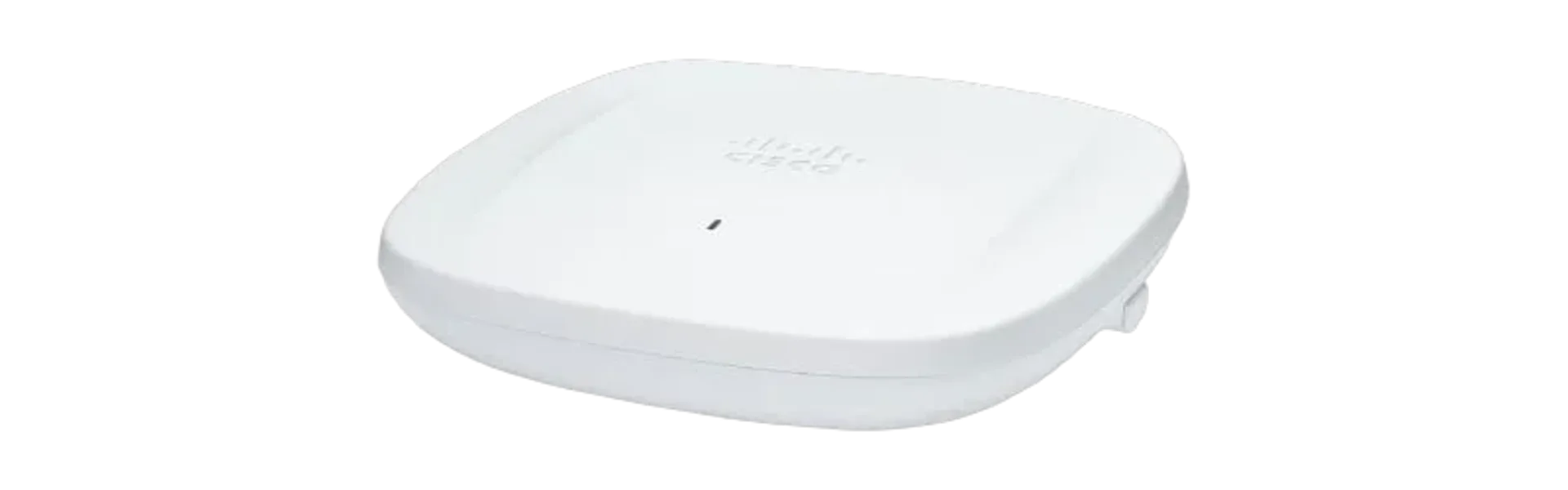
Cisco Catalyst 9166 Series: the hardware decision in one view
Cisco Catalyst 9166 Series access points are enterprise Wi-Fi 6E platforms built around three 4×4 radios, a 5-Gigabit multigigabit Ethernet uplink, integrated environmental sensing, BLE 5.1, IoT application hosting, and a choice between on-premises Catalyst management and cloud-based Meraki management. The procurement decision is primarily between the integrated omnidirectional CW9166I-x and the integrated directional CW9166D1-x. The cloud-managed variants are CW9166I-MR and CW9166D1-MR.
The CW9166I-x is the general-purpose choice for offices, classrooms, healthcare spaces, retail floors, and other areas requiring broad horizontal coverage. The CW9166D1-x is intended for high ceilings and large open spaces where a directional antenna pattern can concentrate radio energy more effectively, such as auditoriums, warehouses, and selected industrial areas. Both models provide the same principal radio architecture, interface capability, memory, and power behavior, but their antenna gain, pattern, and operating-temperature specifications differ.
The access point should not be selected only by its headline PHY rate. The practical design must also account for client capabilities, channel width, regulatory approval, RF interference, wired uplink capacity, PoE class, management mode, and the density of simultaneous traffic. The datasheet specifies PHY data rates up to 7.78 Gbps across the radios, but this is not equivalent to aggregate application throughput available to end users.
CW9166I-x and CW9166D1-x hardware split
The most important physical distinction is antenna geometry. The CW9166I-x uses internal omnidirectional antennas, while the CW9166D1-x uses internal directional antennas. This changes cell shape and mounting strategy rather than creating a simple faster-versus-slower product hierarchy.
| Model family | Antenna design | 2.4-GHz gain | 5-GHz gain | 6-GHz gain | Recommended environment |
|---|---|---|---|---|---|
| CW9166I-x | Integrated omnidirectional | 3 dBi | 5 dBi | 4 dBi | Offices, classrooms, retail, healthcare, standard indoor coverage |
| CW9166D1-x | Integrated directional | 6 dBi | 6 dBi | 8 dBi | Auditoriums, warehouses, high ceilings, large open areas |
| CW9166I-MR | Integrated omnidirectional with Meraki management | 3 dBi | 5 dBi | 4 dBi | Cloud-managed deployments requiring broad coverage |
| CW9166D1-MR | Integrated directional with Meraki management | 6 dBi | 6 dBi | 8 dBi | Cloud-managed large-space and directional coverage deployments |
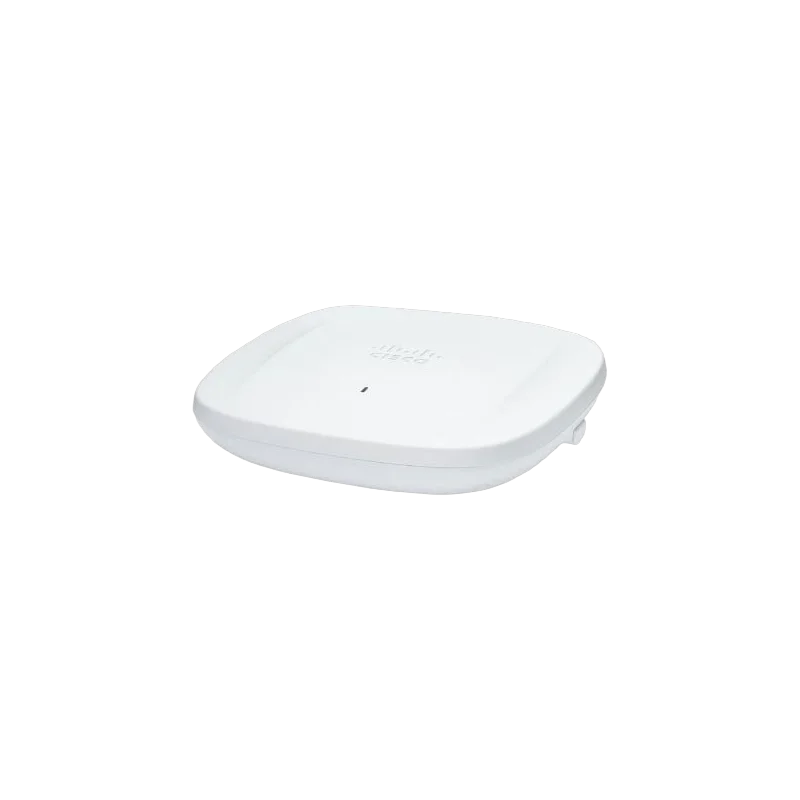
The CW9166I-x measures 9.5 x 9.5 x 2.2 inches, or 241.3 x 241.3 x 56.9 millimeters, and weighs 3.54 pounds, or 1.60 kilograms, without mounting brackets. The CW9166D1-x has the same width and length but is 2.28 inches, or 57.9 millimeters, high, with a listed weight of 3.50 pounds, or 1.59 kilograms.
The directional model should not be treated as a universal replacement for the omnidirectional model. A directional pattern may be advantageous when the coverage area is predictable and elongated, but it requires more deliberate placement and orientation. In a conventional office with users distributed around the access point, the CW9166I-x generally aligns more naturally with the required coverage pattern.
Three-radio architecture and 6-GHz operating behavior
Each Catalyst 9166 model provides 4×4 radio operation on 2.4 GHz, 5 GHz, and 6 GHz when the available power, software, and regulatory conditions permit. The dual-band XOR radio can shift capacity between 6 GHz and a secondary 5-GHz radio. This gives the design team flexibility to prioritize newer 6-GHz clients or preserve additional 5-GHz capacity for legacy devices.
The 802.11ax specification includes 1024-QAM, uplink and downlink OFDMA, uplink and downlink MU-MIMO, Target Wake Time, BSS coloring, beamforming, and WPA3 support. The stated PHY rate ceiling is up to 7.78 Gbps using 4×4 160-MHz operation on 6 GHz, 4×4 80-MHz operation on 5 GHz, and 4×4 20-MHz operation on 2.4 GHz. These figures describe radio-layer signaling under specified conditions. They do not represent guaranteed TCP throughput, per-client bandwidth, or the capacity of the wired network.
The 6-GHz band is particularly sensitive to planning assumptions. In countries where 6-GHz operation is not authorized or where the applicable software support is unavailable, the 6-GHz radio is disabled and the access point operates as a dual-5-GHz platform. The listed 6-GHz transmit values are for Low Power Indoor operation. Country approval and the regulatory-domain suffix must therefore be confirmed before ordering.
Client steering directs capable Wi-Fi 6E clients toward 6 GHz, helping reserve 2.4 GHz and 5 GHz capacity for devices that cannot use the newer band. OFDMA divides channel resources into smaller resource units, allowing multiple clients to be scheduled more efficiently. BSS coloring supports spatial reuse, while MU-MIMO distributes spatial streams among multiple clients. These features improve airtime utilization, but the benefit depends on client support, RF conditions, channel planning, and traffic patterns.
Uplink, USB, and PoE sizing
The Catalyst 9166 Series includes one RJ-45 100M/1000M/2.5G/5G multigigabit Ethernet interface, one RJ-45 management console port, and one USB 2.0 port rated at 4.5 watts. The 5-Gigabit uplink is an important part of the design because the theoretical aggregate radio capacity exceeds the speed of a conventional 1-Gigabit access connection.
| Power source | Radio state | Link speed | USB | Maximum listed PoE consumption | Engineering interpretation |
|---|---|---|---|---|---|
| 802.3bt or Cisco UPOE | 4×4 on 2.4, 5, and 6 GHz | 5 Gbps | Supported | 30.5 W | Full radio operation plus USB-powered workload |
| 802.3at PoE+ | 4×4 on 2.4, 5, and 6 GHz | 5 Gbps | Not supported | 25.5 W | Full radio operation without USB power |
| 802.3af PoE | Radios unavailable for normal service | 1 Gbps | Not supported | 14.0 W | Configuration staging only |
| DC power | 4×4 on 2.4, 5, and 6 GHz | 5 Gbps | Supported | Not stated as PoE consumption | Useful where local DC power is engineered |
Supported power inputs include 802.3bt, Cisco Universal PoE, 802.3at PoE+, Cisco power injectors AIR-PWRINJ7=, AIR-PWRINJ6=, and MA-INJ-6, plus DC input through MA-PWR-50WAC. Cisco identifies 802.3af as suitable only for configuration staging, with all radios disabled. It should not be treated as an operational deployment power option.
At 802.3at PoE+, the radios remain in 4×4 operation and the uplink can run at 5 Gbps, but the USB port is unavailable. A design using USB-connected modules or USB-powered applications should use 802.3bt, Cisco UPOE, or DC power. Actual consumption varies with access point activity, so LLDP or CDP should be enabled to support correct power negotiation.
A 5-Gigabit access switch port is preferable when the WLAN is expected to carry dense concurrent traffic, high-bitrate collaboration, wireless imaging, or substantial IoT traffic. A 1-Gigabit connection may still be acceptable for staging, low-utilization locations, or environments where upstream traffic is intentionally constrained, but it creates a clear wired-side ceiling that cannot be solved by wider wireless channels.
Cisco IOS XE and management choices
The Catalyst 9166 Series supports two operational management paths. In an on-premises architecture, the access points are managed by Cisco Catalyst 9800 Series Wireless Controllers or supported Cisco Catalyst 9000 switches with Embedded Wireless Controller in Software-Defined Access mode. The product also supports cloud management through the Meraki Dashboard using the CW9166I-MR and CW9166D1-MR ordering variants.
The Cisco Catalyst operating path uses Cisco IOS XE software. The datasheet lists Catalyst 9166I support beginning with Cisco IOS XE Software Release 17.9.1 or later and Catalyst 9166D1 support beginning with Cisco IOS XE Software Release 17.12.1 or later. These are software-version requirements, not a substitute for validating controller interoperability and the intended feature set before deployment.
| Management path | Hardware ordering direction | Best fit | Operational emphasis |
|---|---|---|---|
| Catalyst on-premises | CW9166I-x or CW9166D1-x | Organizations operating Catalyst 9800 infrastructure | Centralized controller policy, Cisco DNA integration, SD-Access support |
| Meraki cloud | CW9166I-MR or CW9166D1-MR | Distributed sites seeking dashboard-based operations | Cloud monitoring, policy deployment, health optimization, multi-site administration |
The management decision should be made before finalizing the bill of materials. The same access point hardware can be moved between on-premises and cloud-oriented operational strategies according to the product’s stated management flexibility, but the ordering suffix and licensing path must match the selected deployment model.
Cisco DNA and Catalyst 9800 deployments can use Cisco Spaces, Cisco Identity Services Engine, Cisco DNA Analytics and Assurance, and Intelligent Capture. Intelligent Capture can inspect the network, identify more than 240 anomaly categories, and support packet-level analysis on demand. The Meraki path provides dashboard-based monitoring and management, along with Meraki Health intelligent optimization and assurance. Cisco also identifies support for Meraki Vision cameras and sensors in the cloud-managed ecosystem.
Application hosting, sensing, and security controls
The access point includes environmental sensors for total volatile organic compounds, temperature, and humidity. This allows selected facility and workplace monitoring functions to be placed on the wireless infrastructure instead of deploying a separate sensor overlay. Sensor readings should still be evaluated against the organization’s environmental-monitoring requirements; the presence of a sensor does not define the complete facilities-management system.
Application hosting uses the USB interface and containerized applications to support edge IoT workloads. The practical architecture is an access point with a network-facing uplink, a locally hosted application or hardware module, and a management workflow that controls the application lifecycle. Cisco positions Cisco DNA Center as the platform for deployment-wide application lifecycle management in this model. A USB-powered workload requires the higher power class because the PoE+ profile does not provide USB availability.
Bluetooth Low Energy 5.1 supports location-related use cases such as asset tracking, wayfinding, and analytics. Target Wake Time can allow compatible battery-operated clients to sleep between scheduled exchanges, reducing unnecessary radio activity. These capabilities are most useful when the client ecosystem and application platform are selected together rather than added as isolated features.
The security foundation includes Cisco Trust Anchor Technologies, image signing, Secure Boot, and a Cisco Trust Anchor module. Wireless security options include WPA2-Personal, WPA2-Enterprise with 802.1X, WPA3-Personal, WPA3-Enterprise, and WPA3 Enhanced Open. Supported EAP methods include EAP-TLS, EAP-TTLS with MSCHAP version 2, PEAP, EAP-FAST, GTC variants, and EAP-SIM. The access point also supports AES encryption.
Deployment topology one: dense office or education floor
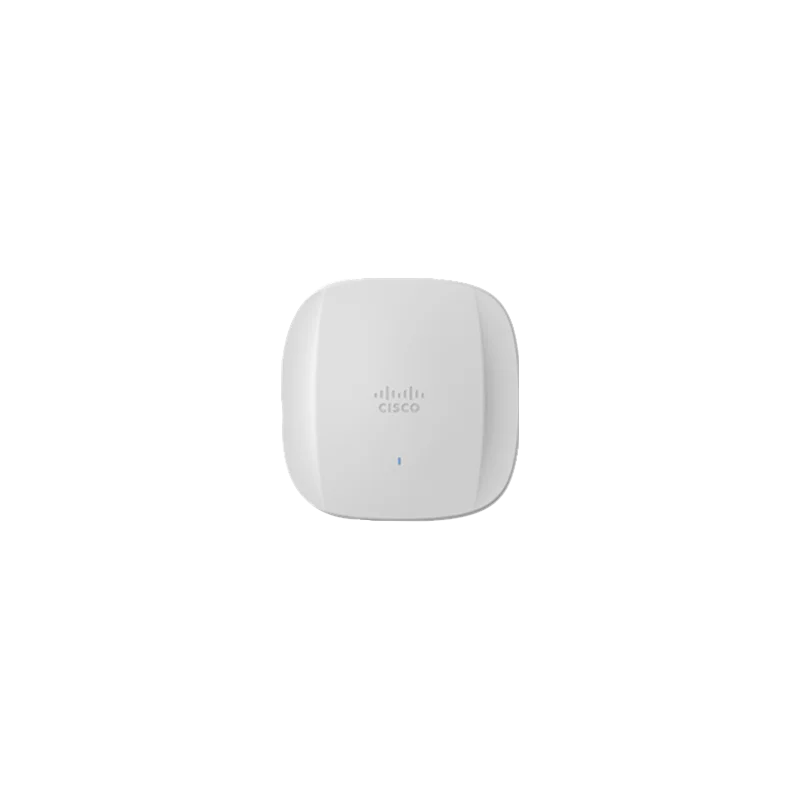
For a dense office, university teaching area, or healthcare administrative floor, the CW9166I-x is normally the stronger physical match because users surround the access point across multiple directions. A typical design sequence is:
- Map user zones, wall materials, ceiling height, and expected client concentration.
- Reserve 6-GHz capacity for compatible Wi-Fi 6E clients while preserving 5-GHz service for older equipment.
- Connect the access point to a 2.5-Gigabit or 5-Gigabit switch interface where traffic demand justifies it.
- Use 802.3at PoE+ when USB applications are not required and 802.3bt when USB-powered workloads are planned.
- Enable LLDP or CDP so the access point and switch can negotiate the intended power state.
- Validate regulatory-domain approval before selecting the suffix represented by x.
- Use Catalyst 9800 and Cisco DNA when the organization already operates controller-based Cisco policy and assurance workflows.
This topology should be sized by airtime and concurrent demand rather than by the maximum PHY number. A room with many low-bandwidth sensors can have a different design requirement from a smaller room with high-definition collaboration, wireless imaging, and frequent large file transfers. The 5-Gigabit uplink provides more headroom, but it does not remove RF contention or upstream firewall and distribution-layer limits.
Deployment topology two: warehouse, auditorium, or high-ceiling space
For a warehouse aisle, auditorium seating bowl, or large open area with predictable user direction, the CW9166D1-x can simplify coverage by using its integrated directional antenna. It avoids the need for an external antenna assembly where the directional pattern is appropriate.
A practical design workflow includes:
- Identify the intended coverage corridor and mounting orientation before final placement.
- Confirm that the directional pattern aligns with the user area rather than adjacent walls or empty space.
- Assess ceiling height, racking, metal obstructions, forklifts, machinery, and reflective surfaces.
- Use 802.3bt or Cisco UPOE if USB application hosting is required.
- Use a 5-Gigabit uplink when the zone will carry dense simultaneous traffic.
- Validate the operating-temperature requirement for the installation location.
- Perform a post-installation RF survey because directional gain does not guarantee uniform service throughout an irregular space.
The CW9166D1-x has a broader operating-temperature range than the CW9166I-x in the supplied specifications, with operation listed from -20 to 50 degrees Celsius compared with 0 to 50 degrees Celsius for the omnidirectional model. That distinction may matter in semi-conditioned environments, but it does not remove the need to assess humidity, dust, condensation, heat sources, and enclosure conditions.
Licensing, warranty, and procurement checks
The datasheet identifies two licensing approaches: unified wireless licensing through the Cisco Networking Subscription and Cisco Enterprise Agreement, or Cisco DNA wireless licensing. Unified licensing provides Wireless Essentials and Wireless Advantage tiers. Cisco describes these tiers as combining wireless capability with subscription-based management, monitoring, and assurance, with exact functionality depending on the access point, software release, deployment model, and management platform.
Cisco DNA wireless licensing is offered in Essentials and Advantage tiers. Cisco DNA Essentials covers foundational automation, management, visibility, monitoring, and assurance. Cisco DNA Advantage adds advanced assurance, analytics, policy-based automation, segmentation, security, location, and application-experience capabilities. Corresponding perpetual network entitlements are Network Essentials and Network Advantage.
The source does not provide a price, inventory position, or product-specific license quantity. Procurement should therefore verify the required subscription tier, management platform, term, Smart Account assignment, and controller or cloud entitlement in the final quotation rather than assuming that the access point hardware alone includes every software capability.
The hardware carries a limited lifetime warranty identified as WARR-CW-LIFE-LTD. The supplied warranty description includes hardware coverage while the original end user continues to own or use the product, five-day advance hardware replacement, and software-media defect coverage for a limited period. Warranty terms should be checked against the purchase configuration and applicable regional conditions.
Final selection checklist for CW9166 hardware
Choose CW9166I-x when the site needs integrated omnidirectional coverage across a conventional indoor floor. Choose CW9166D1-x when the coverage target is directional, elevated, elongated, or located in a large open area. Choose the -MR variants when Meraki Dashboard management is the intended operational model; choose the regulatory-domain variants when operating with Catalyst 9800 or another supported on-premises architecture.
Before issuing a purchase request, verify these items:
- Exact hardware SKU: CW9166I-x, CW9166D1-x, CW9166I-MR, or CW9166D1-MR.
- Country approval and regulatory-domain suffix.
- Catalyst IOS XE controller compatibility or Meraki management requirement.
- 5-Gigabit switch-port availability and upstream capacity.
- 802.3at versus 802.3bt power allocation.
- USB requirement for application hosting or external modules.
- Antenna pattern, mounting direction, ceiling height, and RF obstructions.
- Cisco Wireless Essentials or Advantage, or Cisco DNA Essentials or Advantage.
- Smart Account and subscription administration requirements.
- Warranty and replacement expectations for the completed bill of materials.
For a deployment quote, submit the selected SKU, regulatory domain, management mode, expected access point count, switch-port speed, PoE class, USB workload requirement, mounting environment, and desired licensing tier through the standard ITMALL.SALE RFQ process.