
Cisco N9500 R-Series line cards for modular switching
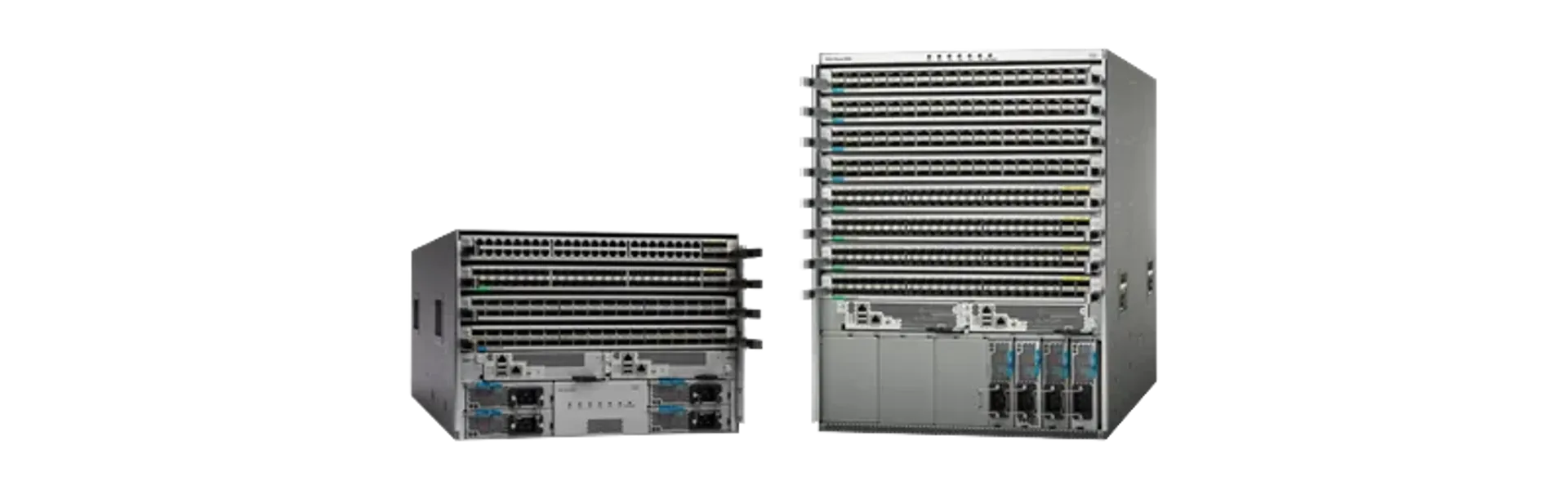
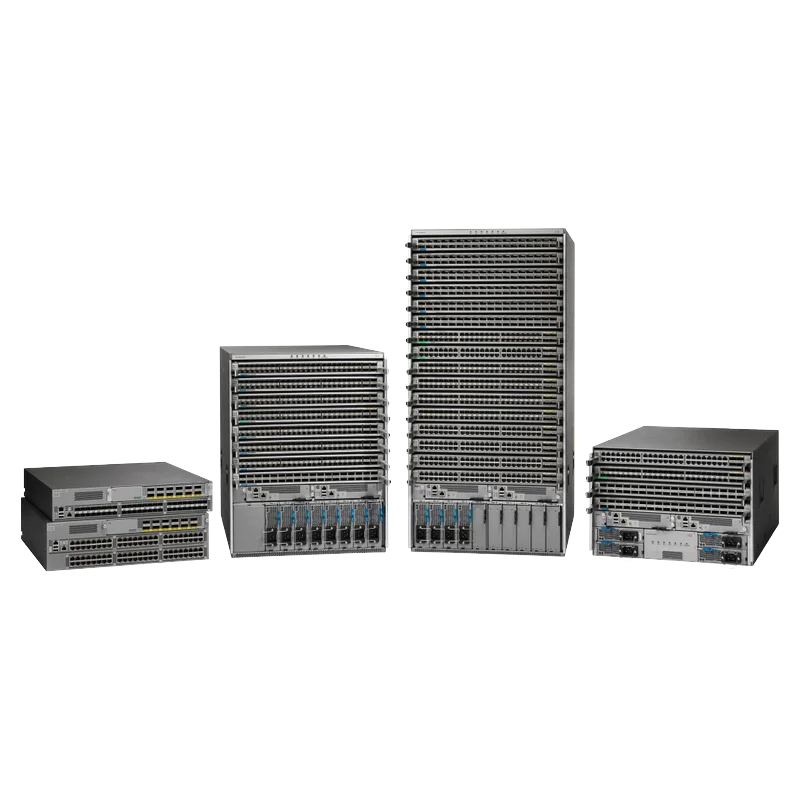
Cisco N9500 R-Series line cards and fabric modules extend the Cisco N9500 modular switching platform with interfaces from 1 Gigabit Ethernet through 400 Gigabit Ethernet. The platform uses 4-slot and 8-slot chassis, with a maximum of 9.6 Tbps per slot and up to 76.8 Tbps in the 8-slot chassis. This page focuses on the verified hardware capabilities, fabric-module relationships, mechanical values, regulatory information, and ordering identifiers needed for data-center planning.
The source is a Cisco data sheet and specifies hardware capabilities only. Cisco NX-OS release notes and feature documentation are required for software feature details.
Cisco N9500 R-Series line card portfolio
The Cisco N9500 R-Series line cards provide different port densities and interface generations for modular switching designs. The range includes a 400/100-Gigabit Ethernet QSFP-DD card, 100-Gigabit Ethernet QSFP28 cards, a 40-Gigabit Ethernet QSFP card, and a mixed-speed SFP/QSFP card with MACsec.
The N9K-X9624D-R2 is the highest-capacity line card listed in the data sheet, with 24 ports supporting 400/100 Gigabit Ethernet through QSFP-DD. The N9K-X9636C-RX and N9K-X9636C-R provide 36-port 40/100-Gigabit Ethernet QSFP28 connectivity, while the N9K-X9636Q-R provides 36 ports of 40-Gigabit Ethernet. The N9K-X96136YC-R combines 1/10/25-Gigabit SFP interfaces with 40/100-Gigabit QSFP interfaces and includes MACsec.
| Line-card type | Description |
| 400-Gbps line card | |
| N9K-X9624D-R2 | 24-port 400/100 Gigabit Ethernet Quad Small Form-Factor Pluggable Double Density (QSFP-DD) line card |
| 100-Gbps line cards | |
| N9K-X9636C-RX | 36-port 40/100 Gigabit Ethernet QSFP28 line card with additional TCAM |
| N9K-X9636C-R | 36-port 40/100 Gigabit Ethernet QSFP28 line card |
| 40-Gbps line cards | |
| N9K-X9636Q-R | 36-port 40 Gigabit Ethernet QSFP line card |
| 10/25-Gbps line cards | |
| N9K-X96136YC-R | 32-port 1/10/25, 16-port 1/10, and 4-port 40/100 Gigabit Ethernet SFP/QSFP line card with MACsec |
Cisco N9500 R-Series performance and scale
The hardware comparison shows substantial differences in performance, processor resources, packet buffers, and route scale. The N9K-X9624D-R2 provides 9.6 Tbps of performance, while the N9K-X9636C-RX and N9K-X9636C-R provide 3.6 Tbps. The N9K-X9636Q-R provides 1.4 Tbps, and the N9K-X96136YC-R provides 1.2 Tbps.
For procurement, fabric-module quantity must be evaluated with the selected line card. Maximum-bandwidth requirements and redundancy requirements are not identical across the portfolio. The N9K-X9636C-R supports six R Series fabric modules for maximum bandwidth and six for N+1 redundancy. The N9K-X9636Q-R supports four R Series fabric modules for maximum bandwidth, five for N+1, or six for N+2. Other combinations in the comparison table are marked N/A for the stated redundancy field.
| Feature/line card | X9624D-R2 | X9636C-RX | X9636C-R | X9636Q-R | X96136YC-R |
| Performance | 9.6 Tbps | 3.6 Tbps | 3.6 Tbps | 1.4 Tbps | 1.2 Tbps |
| Fabric modules required for maximum bandwidth – R2 Series Fabric Module | 6 | 6 | 6 | 6 | 6 |
| Fabric modules required for maximum bandwidth – R Series Fabric Module | 6 | 6 | 5 | 4 | 6 |
| Fabric modules required for N+1 redundancy – R Sereis Fabric Module | N/A | N/A | 6 (N+1) | 5 (N+1) or 6 (N+2) | N/A |
| Supervisor Module | N9K-SUP-B+ | N9K-SUP-B, N9K-SUP-B+ | N9K-SUP-B, N9K-SUP-B+ | N9K-SUP-B, N9K-SUP-B+ | N9K-SUP-B, N9K-SUP-B+ |
| Processor and DRAM | 6-core 1.9 GHz x64 16 GB DDR4 | 4-core 2.4 GHz x64 32 GB DDR4 | 8-core 2.4 GHz x64 16 GB DDR3 | 8-core 2.4 GHz x64 16 GB DDR3 | 4-core 2.4-GHz x64 8 GB DDR4 |
| Packet buffer | 16 GB | 16 GB | 24 GB | 12 GB | 4 GB |
| Maximum number of IPv4 routes | 750,000 | 2,000,000 | 750,000 | 750,000 | 750,000 |
| Maximum number of MAC address entries | 750,000 | 750,000 | 750,000 | 750,000 | 750,000 |
| Number of multicast routes | 250,000 | 250,000 | 250,000 | 250,000 | 250,000 |
| Maximum number of VLANs | 4096 | 4096 | 4096 | 4096 | 4096 |
| Maximum number of links in a port channel | 32 | 32 | 32 | 32 | 32 |
| Maximum number of equal-cost multipathing (ECMP) routes | 256 | 256 | 256 | 256 | 256 |
| Maximum number of port channels | 1000 | 1000 | 1000 | 1000 | 1000 |
| Number of active Cisco Switched Port Analyzer (SPAN) sessions | 32 | 32 | 32 | 32 | 32 |
Cisco N9500 fabric-module support matrix
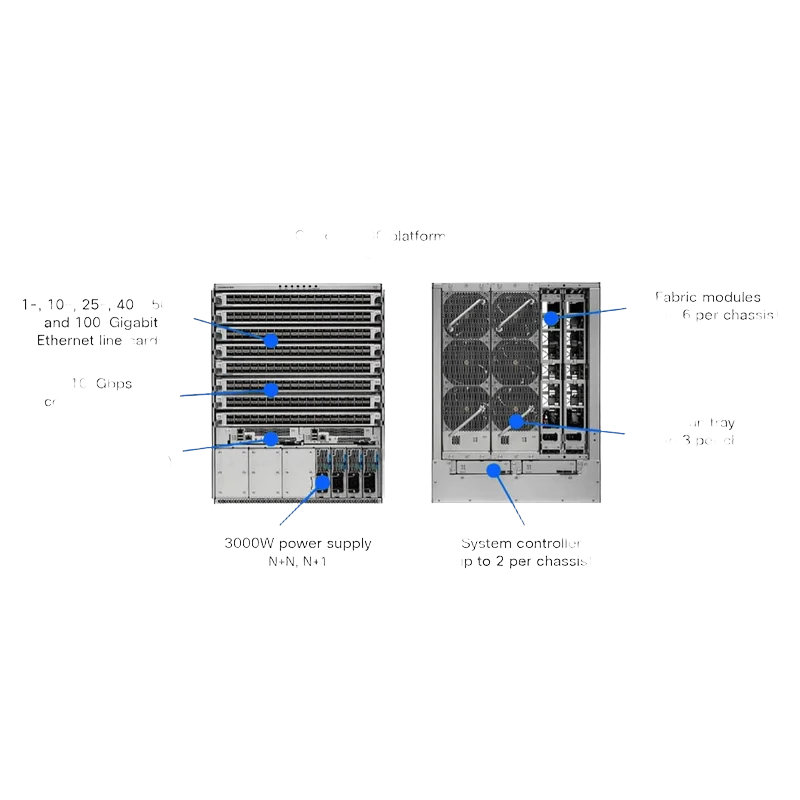
Cisco N9500 R-Series line cards connect to rear-mounted fabric modules in a Clos fabric. Traffic between line cards is load balanced across the fabric modules. The data sheet states that the platform continues operating after loss of a fabric module, with lower capacity as the remaining fabric modules continue providing switching capacity. Some line cards can connect to additional fabric modules for N+1 or N+2 redundancy.
The support matrix below identifies the listed relationships among the line cards and N9500 fabric modules. It should be read together with the required quantity and maximum-bandwidth information above.
| N9K-C9508-FM-R2 | N9K-C9508-FM-R | N9K-C9504-FM-R | |
| X9624D-R2 | Supported | NA | NA |
| X9636C-RX | Supported | Supported | Supported |
| X9636C-R | Supported | Supported | Supported |
| X9636Q-R | Supported | Supported | Supported |
| X96136YC-R | Supported | Supported | Supported |
Cisco N9500 R-Series mechanical and power values
Mechanical planning requires separate consideration of line-card weight, typical power, maximum power, and MTBF values. The N9K-X9624D-R2 has a listed typical power of 900 W and maximum power of 1180 W. The N9K-X9636C-RX is listed at 800 W typical and 1100 W maximum. Lower listed power values apply to the N9K-X9636Q-R and N9K-X96136YC-R.
The fabric modules also have individual mechanical and power values. N9K-C9508-FM-R2 is listed at 280 W typical and 320 W maximum. N9K-C9508-FM-R is listed at 240 W typical and 250 W maximum, while N9K-C9504-FM-R is listed at 115 W typical and 130 W maximum. The source additionally states that N9K-C9508-FM-R2 requires N9K-C9508-FAN2.
| X9624D-R2 | X9636C-RX | X9636C-R | X9636Q-R | X96136YC-R | |
| Weight | 18.17 lb (8.2 kg) | 15.9 lb (7.2 kg) | 12.30 lb (5.58 kg) | 11.48 lb (5.2 kg) | 12.78lb (5.8kg) |
| Typical power | 900 W | 800 W | 650 W | 329 W | 213 W |
| Maximum power | 1180 W | 1100 W | 902 W | 456 W | 300 W |
| Mean Time Between Failure (MTBF) hours | 171,5000 | 262,680 | 239,340 | 273,370 | 545,740 |
| N9K-C9508-FM-R2# | N9K-C9504-FM-R | N9K-C9508-FM-R | |
| Weight | 12.53 lb (5.6 kg) | 62 lb (2.8 kg) | 9.59 lb (4.4 kg) |
| Typical power | 280 W | 115 W | 240 W |
| Maximum power | 320 W | 130 W | 250 W |
| MTBF hours | 465,670 | 908,500 | 840,300 |
Cisco N9500 optics and hardware boundary
Each Cisco N9500 R-Series line card supports an extensive set of optic modules. The data sheet directs buyers to the Cisco Optics Compatibility Matrix for the list of optics supported on each line card. Because the supplied data does not provide the individual optic part numbers, this article does not assign specific transceiver compatibility to any line card.
The data sheet also states that all Cisco N9500 platform R-Series line cards support deep buffers and that some line cards support large tables. These capabilities are hardware statements; software features and release-specific behavior require the appropriate Cisco NX-OS documentation.
Cisco N9500 compliance and ordering information
The listed regulatory information includes CE Markings according to directives 2004/108/EC and 2006/95/EC, UL 60950-1 Second Edition, CAN/CSA-C22.2 No. 60950-1 Second Edition, EN 60950-1 Second Edition, IEC 60950-1 Second Edition, AS/NZS 60950-1, and GB4943. The data sheet also lists Class A emissions and immunity standards, plus RoHS-6 compliance with exceptions for leaded-Ball Grid-Array balls and lead press-fit connectors.
Ordering must distinguish active hardware identifiers from spare identifiers. The equals-sign suffix in the following list identifies the spare entry exactly as shown in the source.
| Part number | Product description |
| N9K-X9624D-R2 | 24-port 400/100 Gigabit Ethernet QSFP-DD line card |
| N9K-X9624D-R2= | 24-port 400/100 Gigabit Ethernet QSFP-DD line card (Spare) |
| N9K-X9636C-RX | 36-port 100 Gigabit Ethernet QSFP28 line card with TCAM |
| N9K-X9636C-RX= | 36-port 100 Gigabit Ethernet QSFP28 line card with TCAM (Spare) |
| N9K-X9636C-R | 36-port 100 Gigabit Ethernet QSFP28 line card |
| N9K-X9636C-R= | 36-port 100 Gigabit Ethernet QSFP28 line card (Spare) |
| N9K-X9636Q-R | 36-port 40 Gigabit Ethernet QSFP line card |
| N9K-X9636Q-R= | 36-port 40 Gigabit Ethernet QSFP line card (Spare) |
| N9K-X96136YC-R | 32-port 1/10/25, 16-port 1/10, and 4-port 40/100 Gigabit Ethernet SFP/QSFP line card with MACsec |
| N9K-X96136YC-R= | 32-port 1/10/25, 16-port 1/10, and 4-port 40/100 Gigabit Ethernet SFP/QSFP line card with MACsec (Spare) |
| N9K-C9508-FM-R2 | Fabric Module for Cisco N9508 R2-Series line cards – Cisco NX-OS only |
| N9K-C9508-FM-R2= | Fabric Module for Cisco N9508 R2-Series line cards – Cisco NX-OS only (Spare) |
| N9K-C9504-FM-R | Fabric Module for Cisco N9504 R-Series line cards – Cisco NX-OS only |
| N9K-C9504-FM-R= | Fabric Module for Cisco N9504 R-Series line cards – Cisco NX-OS only (Spare) |
| N9K-C9508-FM-R | Fabric Module for Cisco N9508 R-Series line cards – Cisco NX-OS only |
| N9K-C9508-FM-R= | Fabric Module for Cisco N9508 R-Series line cards – Cisco NX-OS only (Spare) |
Cisco N9500 R-Series selection checklist
For a Cisco N9500 R-Series line card quotation, confirm the following items before finalizing the bill of materials:
- Select the required interface speed and port density from the line-card portfolio.
- Confirm whether the design requires QSFP-DD, QSFP28, QSFP, or SFP/QSFP interfaces.
- Match the line card with the supported fabric-module options and required quantity.
- Review maximum-bandwidth and redundancy requirements separately.
- Account for typical and maximum power values in chassis planning.
- Include the required supervisor module identified for the selected line card.
- Verify optic part numbers through the Cisco Optics Compatibility Matrix.
- Distinguish standard part numbers from spare part numbers with the exact suffix.
- Confirm software requirements separately because this data sheet covers hardware capabilities only.
ITMALL.SALE can use the Cisco N9500 R-Series line card, fabric-module, supervisor, and optics requirements to prepare a configuration-focused procurement review. Submit the required chassis, interface speed, redundancy, and spare-hardware details through the standard RFQ process.