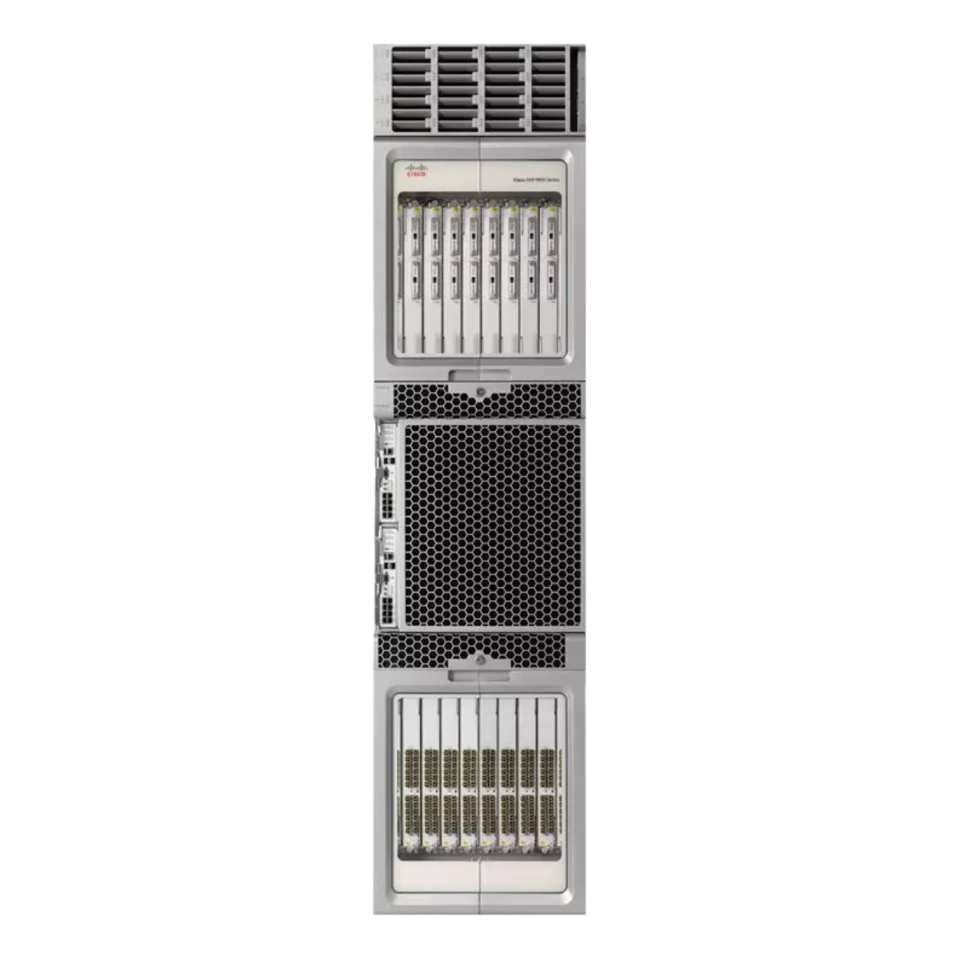
| Features and Benefits |
|---|
| Interface Support | Pluggable 1-Gigabit Small Form-Factor Pluggable (SFP), 10-Gigabit SFP (XFP), and 40-Gigabit Quad SFP (QSFP) interfaces. Provide the capability to mix and match interface types across a single line card; for a complete list of supported interfaces, please see Cisco ASR 9000 Transceiver Modules: Line Card Support data sheet |
| G.709 and Advanced FEC | Standard G.709 providing transmission-layer operations, administration, and maintenance (OA&M); G.709 Standard FEC and Advanced FEC for enhanced transmission system performance |
| Scalable and Integrated Multiservice Support Layer 2 and Layer 3 services | Combined IP, MPLS, Ethernet, Layer 2 VPN (L2VPN), and Layer 3 VPN (L3VPN) services |
| Evolutionary Monitoring Carrier-class OA&M | NetFlow, IEEE 802.1ag, IEEE 802.3ah, ITU Y.1731, IP service-level agreement (IP SLA), virtual circuit connectivity verification (VCCV), ping, and traceroute |
| Evolutionary Monitoring Video monitoring (VidMon) | VidMon, providing real-time monitoring of video flows, including issuance of alarm upon degradation |
| Carrier-Grade OS Cisco IOS XR Software | Modular, patchable, restartable, scalable, highly available, carrier-core and edge-proven operating system |
| T-Class Synchronization Synchronous Ethernet | Derives and provides synchronization from and to Ethernet interfaces, Cisco ASR 9000 Series RSPs, and network synchronization interfaces |
| T-Class Synchronization IEEE 1588-2008 | Cisco ASR 9000 Series support of the IEEE 1588-2008 protocol provides the capability to distribute precision time |
| Product Specifications |
|---|
| Chassis compatibility | Compatible with the Cisco ASR 9922, 9010, 9006 and 9001 systems |
| Port density | Up to 2 modular port adapters are supported per line card. |
| Ethernet IEEE 802.3 compliant | IEEE 802.3 compliant |
| Ethernet 10 Gigabit Ethernet PHY monitoring | 10 Gigabit Ethernet PHY monitoring |
| Ethernet IEEE 802.x flow control | IEEE 802.x flow control |
| Ethernet Full-duplex operation | Full-duplex operation |
| Ethernet Per-port byte and packet counters | Per-port byte and packet counters for policy drops; oversubscription drops; cyclic redundancy check (CRC) error drops; packet sizes; and unicast, multicast, and broadcast packets |
| Card density Maximum number of line cards per system | Cisco ASR 9922 = 20, Cisco ASR 9010 = 8, and Cisco ASR 9006 = 4 |
| Options | Each line card is available as either a Service Edge Optimized (enhanced QoS) or Packet Transport Optimized (basic QoS) line card. |
| Reliability and availability | Line card online insertion and removal (OIR) support without system impact |
| Network Equipment Building Standards (NEBS) Cisco ASR 9000 Series Routers are designed to meet | SR-3580: NEBS Criteria Levels (Level 3); GR-1089-CORE: NEBS EMC and Safety; GR-63-CORE: NEBS Physical Protection |
| Operating temperature (nominal) | 41 to 104ºF (5 to 40ºC) |
| Operating temperature (short-term) | 23 to 131ºF (–5 to 55ºC) |
| Operating humidity (nominal) relative humidity | 10 to 85% |
| Storage temperature | –40 to 158ºF (–40 to 70ºC) |
| Storage relative humidity | 5 to 95%. Note: Not to exceed 0.024 kg of water per kg of dry air |
| Operating altitude | –60 to 4000m (up to 2000m conforms to IEC, EN, UL, and CSA 60950 requirements) |
| ETSI Standards |
|---|
| Cisco ASR 9000 Series Routers are designed to meet | EN300 386: Telecommunications Network Equipment (EMC) |
| ETSI 300 019 Storage Class 1.1 |
| ETSI 300 019 Transportation Class 2.3 |
| ETSI 300 019 Stationary Use Class 3.1 |
| EN55022: Information Technology Equipment (Emissions) |
| EN55024: Information Technology Equipment (Immunity) |
| EN50082-1/EN-61000-6-1: Generic Immunity Standard |
| EMC Standards |
|---|
| Cisco ASR 9000 Series Routers are designed to meet | FCC Class A |
| ICES 003 Class A |
| AS/NZS 3548 Class A |
| CISPR 22 (EN55022) Class A |
| VCCI Class A |
| BSMI Class A |
| IEC/EN 61000-3-2: Power Line Harmonics |
| IEC/EN 61000-3-3: Voltage Fluctuations and Flicker |
| Immunity |
|---|
| Cisco ASR 9000 Series Routers are designed to meet | IEC/EN-61000-4-2: Electrostatic Discharge Immunity (8kV Contact, 15kV Air) |
| IEC/EN-61000-4-3: Radiated Immunity (10V/m) |
| IEC/EN-61000-4-4: Electrical Fast Transient Immunity (2kV Power, 1kV Signal) |
| IEC/EN-61000-4-5: Surge AC Port (4kV CM, 2kV DM) |
| IEC/EN-61000-4-5: Signal Ports (1kV) |
| IEC/EN-61000-4-5: Surge DC Port (1kV) |
| IEC/EN-61000-4-6: Immunity to Conducted Disturbances (10Vrms) |
| IEC/EN-61000-4-8: Power Frequency Magnetic Field Immunity (30A/m) |
| IEC/EN-61000-4-11: Voltage DIPS, Short Interruptions, and Voltage Variations |
| Safety |
|---|
| Cisco ASR 9000 Series Routers are designed to meet | UL/CSA/IEC/EN 60950-1 |
| IEC/EN 60825 Laser Safety |
| ACA TS001 |
| AS/NZS 60950 |
| FDA: Code of Federal Regulations Laser Safety |
| Physical Dimensions and Weights Line Cards |
|---|
| A9K-MOD80-SE/TR | 14.5 W x 1.72 H x 22.40 L; 14.5 W x 1.72 H x 24.25 L (including ejector levers) |
| A9K-MOD80-SE/TR Weight | 17.5 lbs. (est.) (7.93 Kg) |
| A9K-MOD160-SE/TR | 14.5 W x 1.72 H x 22.4 L; 14.5 W x 1.72 H x 24.25 L (including ejector levers) |
| A9K-MOD160-SE/TR Weight | 18 lbs. (8.16 Kg) |
| Physical Dimensions and Weights Modular Port Adapters |
|---|
| A9K-MPA-20x1GE | 6.37 W x 1.36 H x 6.70 L; 6.37 W x 1.36 H x 8.30 L (including Jackscrew) |
| A9K-MPA-20x1GE Weight | 34 oz. (0.96 Kg) |
| A9K-MPA-2x10GE | 6.37 W x 1.36 H x 6.70 L; 6.37 W x 1.36 H x 8.30 L (including Jackscrew) |
| A9K-MPA-2x10GE Weight | 28 oz. (0.7 Kg) |
| A9K-MPA-4x10GE | 6.37 W x 1.36 H x 6.70 L; 6.37 W x 1.36 H x 8.30 L (including Jackscrew) |
| A9K-MPA-4x10GE Weight | 31 oz. (0.87 Kg) |
| A9K-MPA-8x10GE | 6.37 W x 1.36 H x 6.70 L; 6.37 W x 1.36 H x 8.30 L (including Jackscrew) |
| A9K-MPA-8x10GE Weight | 1.75 lbs (0.79 Kg) |
| A9K-MPA-1x40GE | 6.37 W x 1.36 H x 6.70 L; 6.37 W x 1.36 H x 8.30 L (including Jackscrew) |
| A9K-MPA-1x40GE Weight | 26 oz. (est.)(0.7 Kg) |
| A9K-MPA-2x40GE | 6.37 W x 1.36 H x 6.70 L; 6.37 W x 1.36 H x 8.30 L (including Jackscrew) |
| A9K-MPA-2x40GE Weight | 28 oz. (0.7 Kg) |
| System Software Requirements |
|---|
| A9K-Mod80 –TR/SE | Cisco IOS XR 4.2.0 |
| A9K-Mod160 –TR/SE | Cisco IOS XR 4.2.1 |
| Line Card Feature Licenses |
|---|
| A9K-IVRF-LIC | Infrastructure VRF license to enable up to 8 VRF instances per Modular line card |
| A9K-MOD80-AIP-SE | Advanced IP license to enable full-scale VRF instances per Service Edge Optimized Mod80 line card |
| A9K-MOD80-AIP-TR | Advanced IP license to enable full-scale VRF instances per Packet Transport Optimized Mod80 line card |
| A9K-MOD80-OPT-LIC | Advanced Optical license to enable G.709 and FEC per Mod80 line card |
| A9K-MOD80-VID-LIC | Advanced Video license to enable inline video monitoring per Mod80 line card |
| A9K-MOD160-AIP-SE | Advanced IP license to enable full-scale VRF instances per Service Edge Optimized Mod160 line card |
| A9K-MOD160-AIP-TR | Advanced IP license to enable full-scale VRF instances per Packet Transport Optimized Mod160 line card |
| A9K-MOD160-OPT-LIC | Advanced Optical license to enable G.709 and FEC per Mod160 line card |
| A9K-MOD160-VID-LIC | Advanced Video license to enable inline video monitoring per Mod160 line card |
| System-Level Feature Licenses |
|---|
| A9K-LI-LIC | Lawful Intercept license to enable lawful intercept of packet streams for surveillance |
| A9K-MOBILE-LIC | Advanced Mobile license to enable Synchronous Ethernet and IEEE 1588-2008 protocols to distribute precision timing and frequency |
| A9K-BNG-LIC-8K | Broadband Network Gateway license to enable high scale Ethernet BNG with session/subscriber awareness |
| A9K-SYS-VID-LIC | Advanced Video license to enable inline video monitoring for all linecards in the system |
| Ordering Information |
|---|
| A9K-MOD80-SE | ASR 9000 Mod80 Modular Line Card, Service Edge Optimized, requires modular port adapters |
| A9K-MOD80-TR | ASR 9000 Mod80 Modular Line Card, Packet Transport Optimized, requires modular port adapters |
| A9K-MOD160-SE | ASR 9000 Mod160 Modular Line Card, Service Edge Optimized, requires modular port adapters |
| A9K-MOD160-TR | ASR 9000 Mod160 Modular Line Card, Packet Transport Optimized, requires modular port adapters |
| A9K-MPA-20x1GE | ASR 9000 20-port 1-Gigabit Ethernet Modular Port Adapter, requires SFP optics |
| A9K-MPA-2x10GE | ASR 9000 2-port 10-Gigabit Ethernet Modular Port Adapter, requires XFP optics |
| A9K-MPA-4x10GE | ASR 9000 4-port 10-Gigabit Ethernet Modular Port Adapter, requires XFP optics |
| A9K-MPA-8x10GE | ASR 9000 8-port 10-Gigabit Ethernet Modular Port Adapter, requires SFP+ optics |
| A9K-MPA-1x40GE | ASR 9000 1-port 40-Gigabit Ethernet Modular Port Adapter, requires QSFP optics |
| A9K-MPA-2x40GE | ASR 9000 2-port 40-Gigabit Ethernet Modular Port Adapter, requires QSFP optics |