
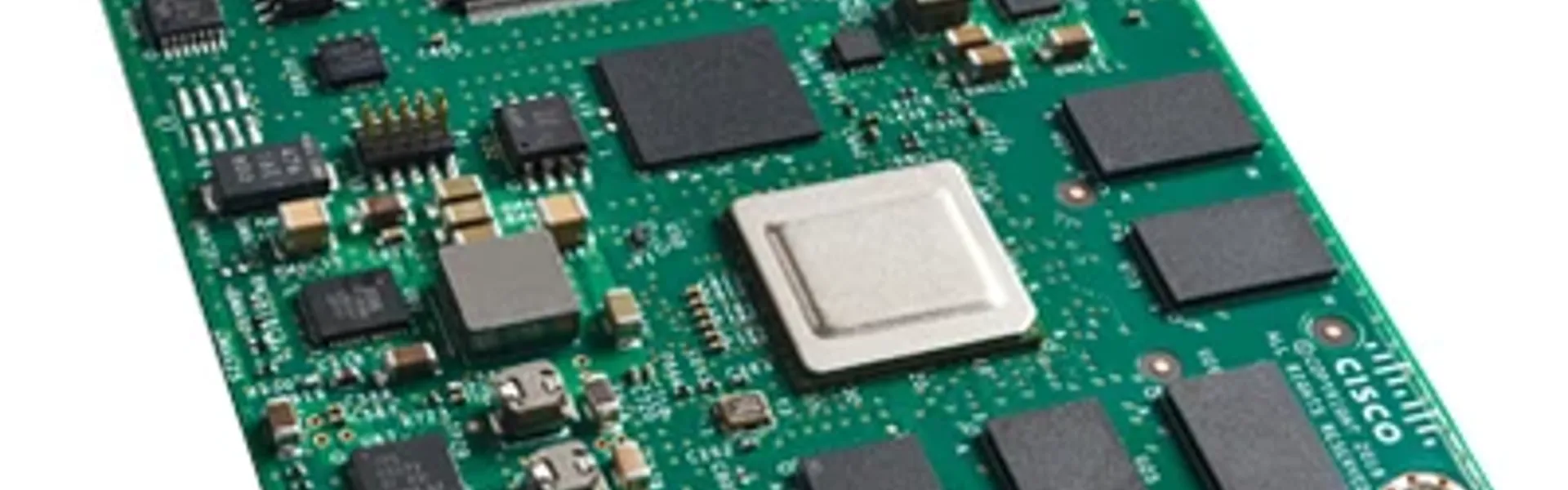
Cisco ESR6300 Embedded Series Router Platform Overview
The Cisco ESR6300 is a compact embedded router module for mobile, industrial, public-safety, transportation, defense, and energy networks. It provides two routed Gigabit Ethernet WAN interfaces and four switched Gigabit Ethernet LAN interfaces, with hardware-accelerated encryption and conduction-cooled or no-cooling-plate variants for integration into purpose-built systems.
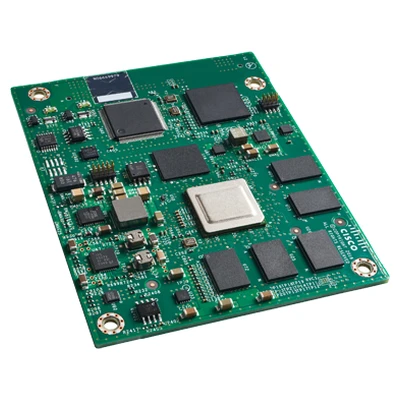
Cisco identifies the ESR6300 as an End-of-Sale / End-of-Life product. For organizations maintaining existing deployments, the key planning priorities are selecting the correct board variant, matching its software tier and throughput license, and keeping an appropriate spare strategy. Cisco’s stated replacement use is for the Cisco 5915 and 5940 Embedded Services Routers; no specific successor model is identified here.
Cisco ESR6300 Embedded Router Architecture and Interfaces
The ESR6300 is an embedded card rather than a standalone rack router. Its compact board format supports integration into commercial or custom enclosures, including systems adapted for PC/104 modules. The conduction-cooled card includes a cooling plate; the NCP variant is supplied without one, allowing the integrator to design the thermal solution.
| Architecture item | Specification |
|---|---|
| Hardware form | Embedded router module |
| Board dimensions (H × W) | 3.0 × 3.775 in. (76.2 × 95.885 mm) |
| Routed Ethernet | 2 Layer 3 Gigabit Ethernet WAN ports |
| Switched Ethernet | 4 Layer 2 Gigabit Ethernet LAN ports with integrated Layer 2 switch |
| Memory | 4-GB DDR4 (32-bit plus 4-bit ECC) |
| Flash | 4-GB usable eMMC flash in pSLC mode |
| Power inputs | 3.3V and 5V |
| Power consumption | 5W idle; 7.5W typical; 12W maximum |
The Ethernet ports require external magnetics and connectors. Enabling PoE or PoE+ on the switched LAN architecture requires the systems integrator to add a PoE/PoE+ controller based on Cisco specifications; this is not a built-in PoE power budget claim.
Cisco ESR6300 Rugged Deployment and Environmental Specifications
The ESR6300 is designed for embedded deployments exposed to temperature extremes, shock, and vibration. The completed system’s environmental capability depends on the enclosure and thermal design supplied by the systems integrator, so validate the full assembled solution rather than treating the board rating as an enclosure rating.
| Parameter | Specification |
|---|---|
| Industrial-grade board component temperature | –40° to 85°C (–40° to 185°F) component local ambient temperature |
| Operating temperature | –40° to 85°C (–40° to 185°F) for conduction-cooled SKUs, measured at the center top surface of the heat spreader plate |
| Storage temperature | –40° to 85°C (–40° to 185°F) |
| Operating altitude | 12,192 m (40,000 ft) |
| Nonoperating altitude | 12,192 m (40,000 ft) |
| Nonoperating shock and vibration | MIL-STD-810, Method 514.4; IEC 68000-2-32; MIL-STD-810 F, Method 516.5, Procedure V Crash Hazard; dependent on packaging |
| Industry standards | IEC 61850-3; IEEE 1613 |
Cisco ESR6300 Software, Routing, and Security Capabilities
The ESR6300 uses a Cisco IOS XE universal image and requires Cisco IOS XE Software Release 17.1.1 or later. Its listed services include IPv4 and IPv6 routing, RIP, OSPF, BGP, EIGRP, GRE and MGRE, NAT, DHCP, ACLs, multicast, VRF Lite, and L2TPv3. The feature set also includes QoS functions such as LLQ, WFQ, CBWFQ, traffic shaping and policing, policy-based routing, and hierarchical QoS.
Security capabilities include hardware-accelerated encryption, SSL VPN, IPsec, DMVPN, FlexVPN, Group Encrypted Transport VPN, IPsec stateful failover, and zone-based firewall features. The platform supports 20 IPsec tunnels. Cisco lists encryption algorithms including AES-256, SHA-384, and SHA-512, along with PKI support. The onboard Trust Anchor module, image signing, Secure Boot, and runtime defenses support platform integrity.
The hardware provides six Gigabit Ethernet interfaces, while licensed throughput tiers set the product’s stated throughput level. Select the tier against the intended traffic profile rather than assuming that the port speeds determine licensed forwarding throughput.
Cisco ESR6300 Licensing and Throughput Selection
The ESR6300 is Smart License-enabled; Cisco Smart Accounts and Virtual Accounts are required for ordering. A software tier and throughput license are mandatory. Network Essentials covers core routing and security functions, while Network Advantage adds features including MPLS, BFD, RSVP, IP SLA, TCP optimization, application-aware QoS, L2TPv3, and Radio Aware Routing.
| Throughput tier | Network Essentials ordering PID | Network Advantage ordering PID |
|---|---|---|
| Default, 50 Mbps | SL-6300-NE/DEF-K9 | SL-6300-NA/DEF-K9 |
| Performance, 250 Mbps | SL-6300-NE/PERF-K9 | SL-6300-NA/PERF-K9 |
| Boost, Uncapped | SL-6300-NE/BOOS-K9 | SL-6300-NA/BOOS-K9 |
The Boost license requires the HSEC license, which Cisco says is automatically included when Boost is selected. Cisco also lists an HSEC license PID in the ordering information. Confirm the order configuration and Smart Licensing activation requirements before procurement.
| License or option | Ordering PID | Procurement note |
|---|---|---|
| HSEC license | L-63-HSEC-K9 | Required with Boost according to the ordering information |
| Cisco Unified Communications Manager Express, 1 seat | CME-UL | Optional; required when using Cisco Unified Communications Manager Express |
| Catalyst Center or Catalyst SD-WAN Manager, on-premises license | L-IR-DNA-TIER-ADD | Listed license option |
| Catalyst Center or Catalyst SD-WAN Manager, cloud license | IOT-IRDNA | Listed license option |
Cisco Unified Communications Manager Express supports up to 48 phones for remote IP telephony on vehicles or at outdoor locations. The per-seat option above is identified as a one-seat license; confirm the required licensing arrangement for the planned deployment.
Cisco ESR6300 Ordering Matrix and Board Variants
Choose the board according to the intended thermal integration. The CON card is conduction-cooled and includes a cooling plate; the NCP card has no cooling plate. Both variants provide two routed and four switched Gigabit Ethernet ports.
| Product configuration | Part number | Cooling configuration |
|---|---|---|
| Cisco ESR6300 no cooling plate card, 2 routed GE and 4 switched GE ports | ESR-6300-NCP-K9 | No cooling plate |
| Cisco ESR6300 conduction-cooled card, 2 routed GE and 4 switched GE ports | ESR-6300-CON-K9 | Cooling plate |
Software license upgrades are available between listed Network Essentials and Network Advantage throughput tiers. The matrix shows the upgrade PIDs; blank cells indicate no PID listed for that transition.
| Current tier | NE/50M | NE/250M | NE/UNC | NA/50M | NA/250M | NA/UNC |
|---|---|---|---|---|---|---|
| NE/50M | — | SL-6300-NE/DP-K9= | SL-6300-NE/DB-K9= | SL-6300-NA/DEF-K9= | SL-6300-NA/DP-K9= | SL-6300-NA/DB-K9= |
| NE/250M | — | — | SL-6300-NE/PB-K9= | — | SL-6300-NA/PER-K9= | SL-6300-NA/PB-K9= |
| NE/UNC | — | — | — | — | — | SL-6300-NAA/BOO-K9= |
| NA/50M | — | — | — | — | SL-6300-NAA/DP-K9= | SL-6300-NAA/DB-K9= |
| NA/250M | — | — | — | — | — | SL-6300-NAA/PB-K9= |
| NA/UNC | — | — | — | — | — | — |
NE means Network Essentials, NA means Network Advantage, and UNC means Uncapped. For example, Cisco lists SL-6300-NA/DB-K9= for an upgrade from NE/50M to NA/UNC.
Cisco ESR6300 Console, Serial, and Integration I/O
The module’s external connections are implemented by the systems integrator using the required interface components. Plan the board-level design for console access, USB, serial data, and alarm input as applicable to the enclosure and deployment.
| Interface | Specification and integration requirement |
|---|---|
| Console UART | 1 UART port; defaults to 9600 baud |
| External console options | 1 USB 2.0 port requiring a USB/UART bridge, or 1 EIA-232 serial console port requiring an EIA-232/UART transceiver |
| USB host | 1 USB 3.0 Type A host port; requires USB connector and 5V VBUS power switch |
| Serial data | EIA-232 DTE; asynchronous mode and flow control up to 921,600 baud |
| Alarm input | ALARM input port; requires an isolated dry-contact open/closed detection circuit |
| LAN PoE readiness | Integrated Layer 2 switch can be PoE/PoE+ enabled with required magnetics, connector, and PoE controller |
Cisco ESR6300 Lifecycle and Installed-Base Planning
Cisco identifies the ESR6300 as End-of-Sale / End-of-Life. The lifecycle information available for this product does not provide specific milestone dates or a named replacement SKU, so procurement and support planning should be based on the applicable Cisco lifecycle bulletin and the customer’s active service entitlements.
For installed systems, keep the board variant and licensed throughput tier aligned with the deployed configuration when sourcing spares. Validate enclosure cooling, interface implementation, and Smart Licensing requirements before replacing or adding a module. Cisco states that the ESR6300 card was designed as a replacement for the Cisco 5915 and 5940 Embedded Services Routers; no later successor model is identified here.